
Scene Understanding /
Scene understanding needs context
How place, task, and operating conditions turn object detections into useful video analytics.
Observe the scene
Define its context
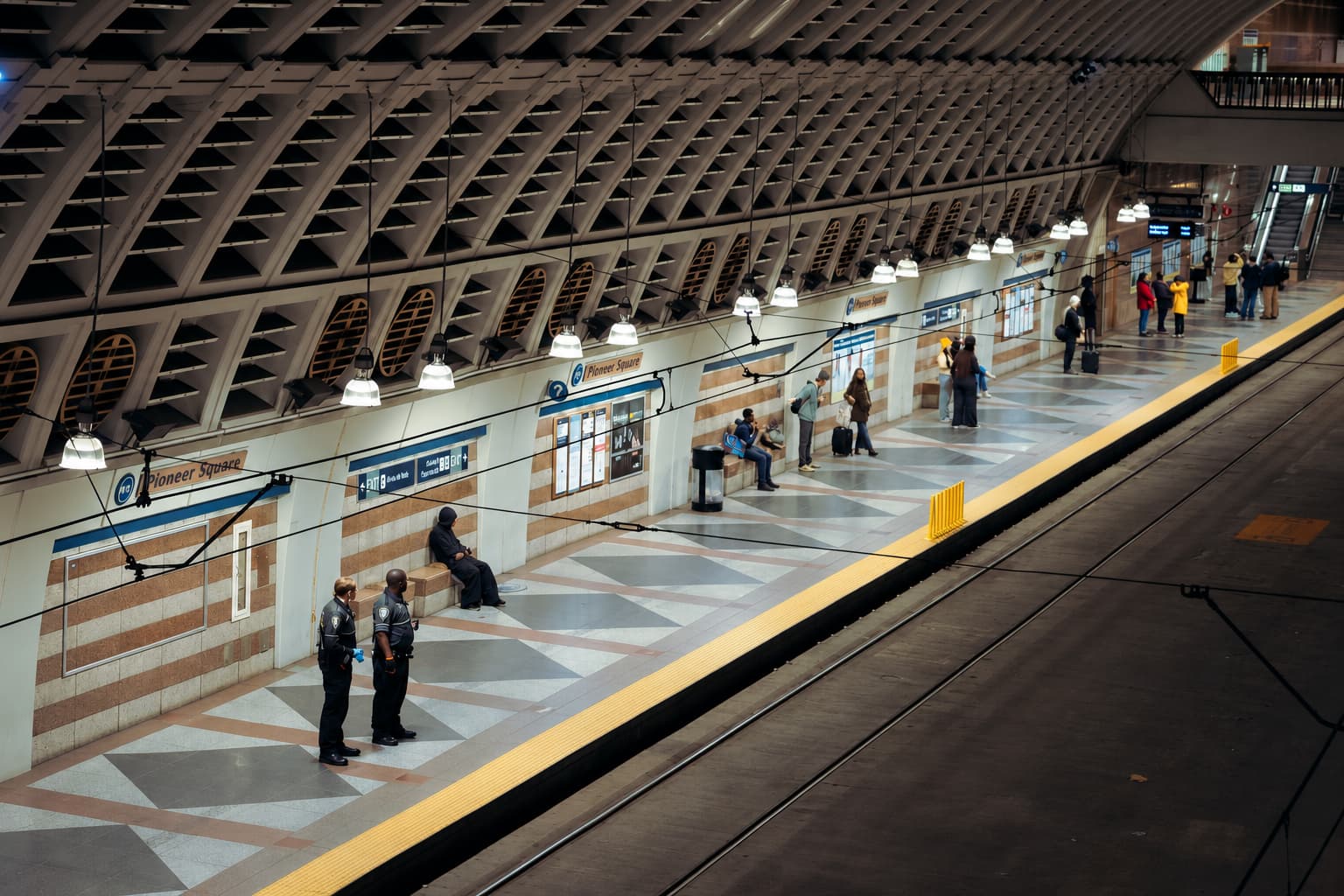
A person standing on a railway platform might be waiting for a train, walking toward an exit, or entering an area that requires attention. Detecting “person” does not distinguish those situations. The distinction comes from where the person is, how they move, what surrounds them, and the operating rules for that place.
Scene understanding connects those observations to a usable description of the environment. For video analytics, that description has to support a specific question: how many people are waiting, how long a vehicle occupies a loading bay, or whether a passage remains accessible. A useful system needs both broad visual understanding and a precise definition of the situation it is measuring.
Objects acquire meaning through relationships
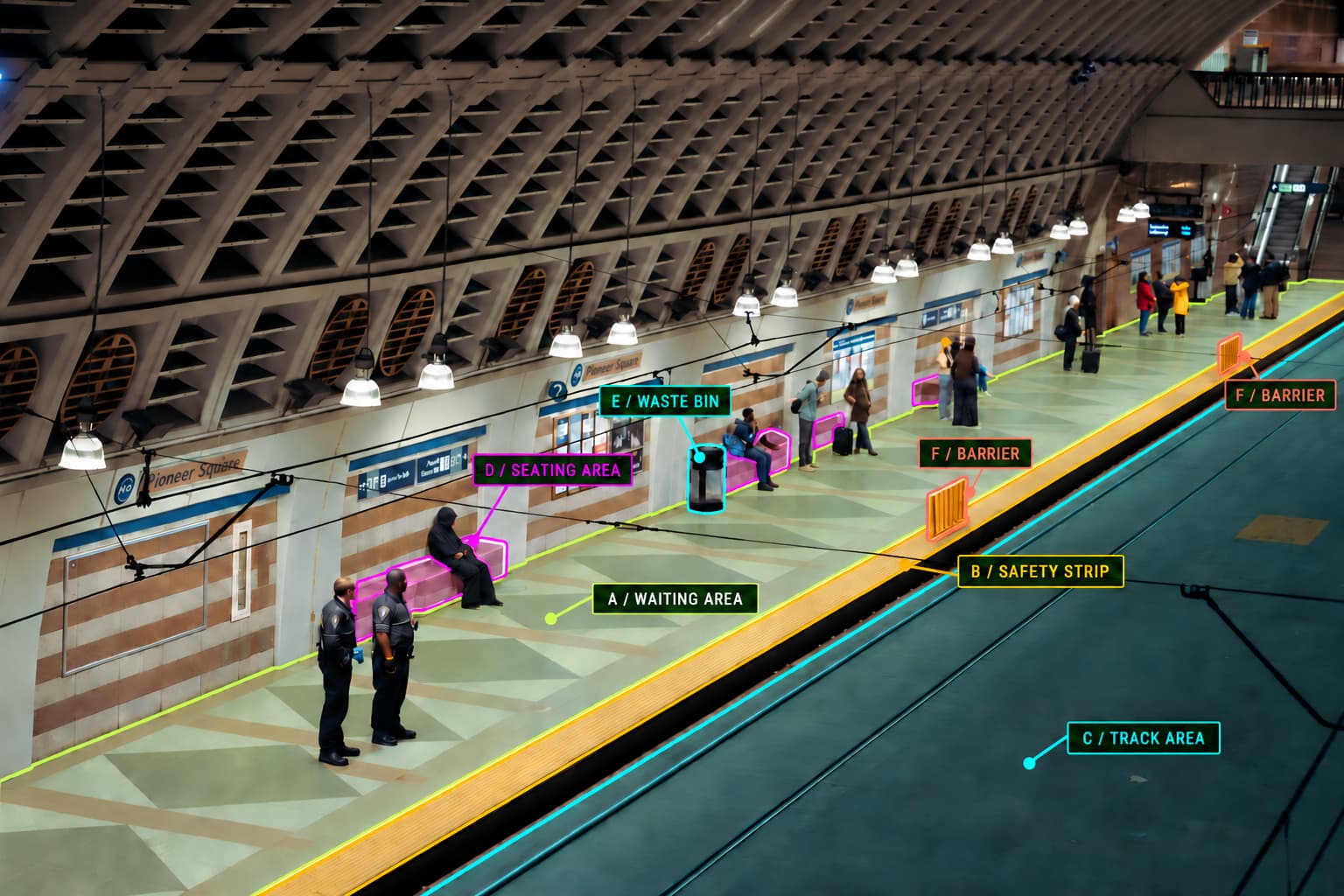
An object detector gives a class, a location in the image, and a confidence score. A site model adds relationships: a seat belongs to a waiting area; a barrier borders a passage; a person occupies a seat during a particular interval. These relationships make it possible to ask operational questions without reinterpreting the entire image every time.
This idea has a long research history. Visual Genome was designed around annotations of objects, attributes, and their relationships, with more than 100,000 images in its original release. Its central argument is relevant here: answering questions about a scene requires modeling how its objects relate to one another. A static image dataset does not solve live video interpretation, but it provides a useful vocabulary for the problem. Krishna et al., Visual Genome.
For the platform pictured above, the same person detection can contribute to several different measurements. Membership in the validated waiting zone contributes to occupancy. A track crossing a configured boundary contributes to a movement count. Continued presence near a seat may require a separate posture or occupancy model before it supports a seating measurement. Each result needs its own definition and evidence.
Fit the model to the measurement
“Situation-specific” describes the fit between the system and its job. It can involve a specialized detector, a model adapted to a domain, calibrated geometry, a tracking configuration, or a rule applied to a sequence of observations. Often, several of these are needed together.
Consider a vehicle stopped beside a curb. A general model may recognize a van and describe its surroundings. To measure loading-bay dwell time, the service still needs the bay boundary, a definition of arrival and departure, a way to maintain the vehicle’s identity, and a policy for periods when another vehicle blocks the view. Calling every stationary van a loading event would produce a measurement with an unclear meaning.
The deployment should therefore make three things explicit:
This also sets a limit on specialization. A model can learn shortcuts tied to one background or camera angle. Site adaptation must improve the intended measurement on held-out footage, including difficult conditions. A high score on familiar frames is insufficient evidence.
Performance can change across camera locations
The WILDS benchmark provides a concrete example. Its iWildCam2020 task classifies animal species from camera-trap images. The baseline’s macro F1 fell from 47.0 on the in-distribution test split to 31.0 on the out-of-distribution split containing unseen camera locations. Macro F1 gives equal weight to each class, making it useful when common species dominate the image count. Koh et al., WILDS, Tables 1 and 4.
Performance falls on unseen cameras
iWildCam2020-WILDS · baseline macro F1 · higher is better
The engineering implication is to validate across cameras as well as across time. Nearby video frames share backgrounds and often show the same objects. Randomly distributing those frames between training and testing can make the evaluation easier than deployment on a new view. Reserve entire cameras, dates, or sites when they represent the generalization the service must support.
Conditions within one site matter too
BDD100K compares the same detector trained on 30,000 images drawn from different lighting conditions. Mixed training performs best on its non-daytime evaluation subset, illustrating why training coverage matters. Yu et al., BDD100K, Table 4.
Training coverage changes the result
BDD100K · AP on the same non-daytime evaluation subset · higher is better
For an installation, this means testing the conditions that actually occur: glare through an entrance, low light, rain on a lens, a moved barrier, or a camera shifted during maintenance. Adaptation may require better data, a different model, or a revised measurement boundary. More specialization alone does not guarantee better generalization.
Time is part of the scene
A single frame rarely establishes a queue, a dwell interval, or an obstruction that persists. Those measurements require continuity. A person can disappear behind a column and reappear; treating that interruption as a departure and a new arrival changes the result.
BDD100K recorded 49,418 occlusions, or one per 3.51 tracks, in its driving-data analysis. A missing detection can reflect a blocked view rather than a departure. Yu et al., §3.6.
The service needs rules for uncertainty. After a short occlusion, a tracker may reconnect an identity. After a longer gap, an interval may need to be marked incomplete. If the camera loses its view of a region, the state should become unknown rather than silently reporting zero occupancy. These choices belong in the measurement specification and in the evidence available to a reviewer.
Give general models and specialized models distinct jobs
Capable vision-language models are useful for interpreting unfamiliar scenes, proposing relevant objects and relationships, and reviewing ambiguous clips. They can help an operator describe what a site contains and what a new question requires. Proposed zones, affordances, and rules still need validation against the actual location.
Recurring measurements benefit from a narrower, testable pipeline: a suitable detector, tracking, site geometry, temporal rules, and quality checks. Escalate unfamiliar situations to a larger model or a person. Review a sample of ordinary footage too, because an escalation process that only sees flagged events cannot discover all missed events.
The companion article on edge inference discusses where that processing should run. The design question here comes first: what exactly must the system understand, and what evidence would show that it understood it correctly?
For Parallel Sight, scene understanding means connecting observations to a model of the place and maintaining that relationship over time. Situation-specific models matter because a useful measurement has a location, a definition, an operating range, and evidence. Model selection should follow those requirements.
Sources and chart data
Charts redrawn from published research. The studies use different tasks and metrics; their scores should not be compared with each other. The platform images illustrate context and do not show a deployed system. Download chart data (CSV).
- Krishna et al. — Visual Genome. Original preprint, 2016; objects, attributes, and relationships.
- Koh et al. — WILDS: A Benchmark of in-the-Wild Distribution Shifts. ICML 2021; Tables 1 and 4.
- Yu et al. — BDD100K: A Diverse Driving Dataset for Heterogeneous Multitask Learning. CVPR 2020; Table 4, §3.6, and §4.1.