Current state
How busy is the waiting area now?
The defined waiting area, its observed occupancy, and the time of the latest observation.
 Parallel SightUnderstanding places.
PLATFORM / SPATIAL & TEMPORAL CONTEXT
Parallel Sight links video observations to a model of each site: its spaces, objects, and relationships. The observations record activity over time.
Each result carries a site location, observation time or interval, measurement definition, and supporting evidence for review.
Agents can use these structured records to ask about a site's current state or history and trace each answer to its evidence.
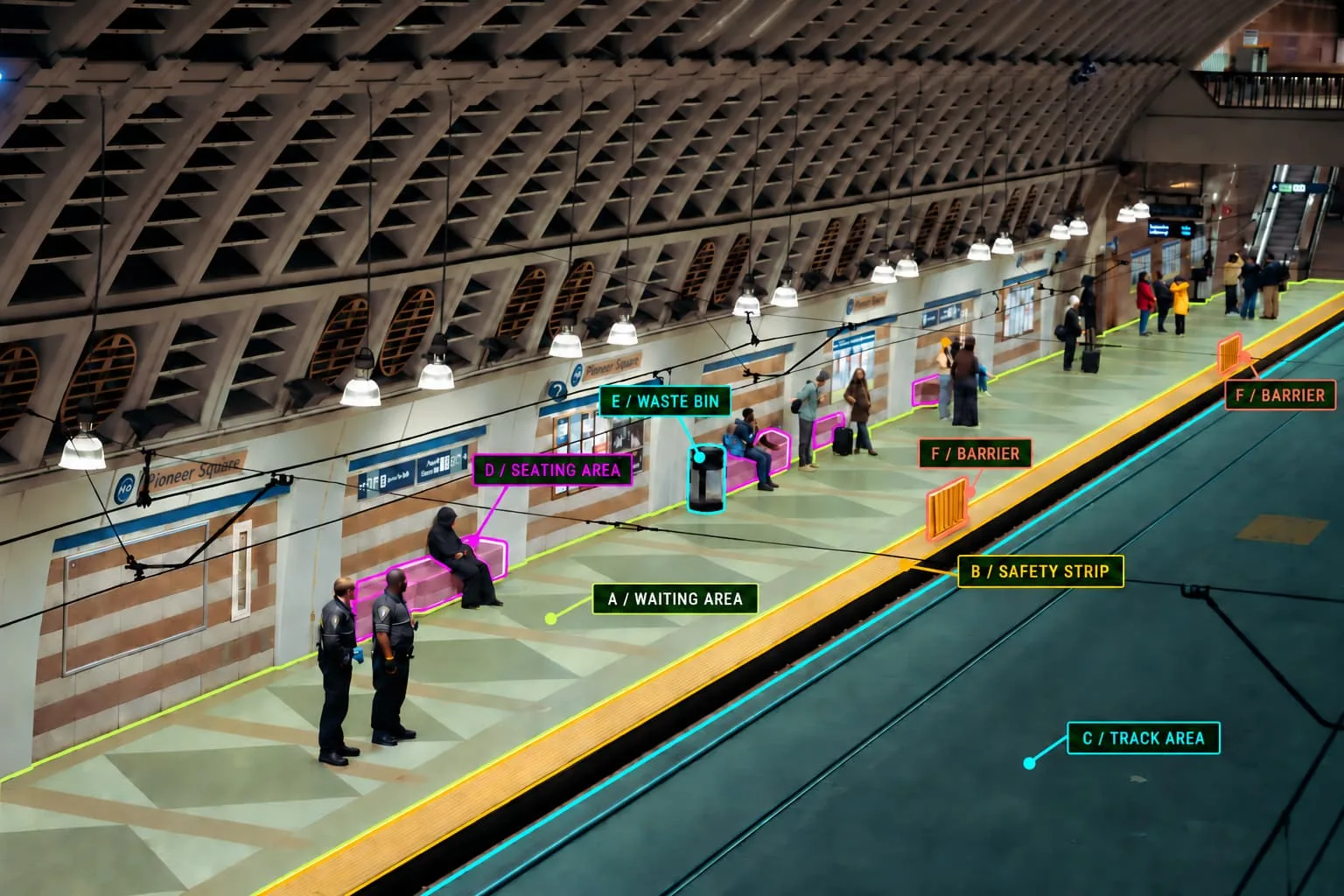
SITE MODELS
A person on a platform may be waiting, moving through a passage, or approaching the edge. The region they occupy helps explain what the observation means.
A site model names the spaces and objects, describes their relationships, and defines relevant activities. Together, these form a site ontology: a shared vocabulary for observations and queries.
contains
Supports waiting
Supports sitting
Borders the track area
The number of observed people in the defined waiting area at a given time.
How does use of the waiting area change during the morning?
OBSERVATIONS & EVIDENCE
A library reading room has twelve defined seats. Its occupancy record shows when those seats are in use and when they become available. Each finding links to the rule and observations behind it.
10:00 10:30
Selected points from the room’s occupancy record
FOR PEOPLE / EXPLAIN THE FINDING
The record shows all twelve seats occupied from 10:00 until 10:30. At 10:30, three seats became available.
FOR SOFTWARE & AGENTS / USE THE SAME RESULT
These fields let software retrieve the finding and its supporting observations.
STRUCTURED ACCESS
The same records support human review and software queries. A query identifies a place, time, or observation; the result includes the definitions and evidence needed to interpret it.
How busy is the waiting area now?
The defined waiting area, its observed occupancy, and the time of the latest observation.
When was the reading room full?
Full-occupancy intervals, their durations, and the rule used to identify them.
What supports the 30-minute finding?
The source observations, timestamps, and seat definitions behind the result.
SYSTEM ARCHITECTURE
Visual observations and site knowledge serve different roles. The system uses site definitions to interpret what cameras observe, then keeps the context behind each measurement.
VISUAL INPUT
Objects, positions, and tracks from recordings and supported camera feeds.
Example: a person observed in the seating areaSITE CONTEXT
Named spaces, object relationships, and rules for interpreting activity.
Example: twelve defined seats in a library reading roomINTERPRET
Associate observations with defined spaces and objects. Preserve uncertainty where the view is incomplete.
Person at a defined seat → occupied seatMEASURE
Calculate state, counts, durations, or events for a specified region and time interval.
12 occupied seats → full roomRETAIN & EXPOSE
Connect the measurement to its source observations and configuration for review and querying.
Full interval → record + evidenceDEPLOYMENT & VALIDATION
Camera coverage and site definitions determine which questions can be answered. Each deployment needs an assessment of its footage, measurement rules, and the conditions under which results are reliable.
Check resolution, lighting, occlusion, and camera geometry. An unobserved area should remain unknown, rather than be treated as empty.
Agree on zone boundaries and event rules. Compare representative results with source footage and record where the interpretation is uncertain.
Recheck the model when cameras move or layouts change. Retain the configuration used for each result so historical comparisons remain meaningful.