
Scene Understanding /
Reasoning about scenes with ontologies
A shared model of objects, spaces, relationships, and time helps video analytics produce information that can be queried and checked.
A camera sees semi-trailers backed into warehouse loading docks. An operator wants to know whether a loading bay is occupied, how long it has been occupied, and whether another vehicle can use it. Answering those questions requires more than recognizing the vehicles. The system needs a definition of the bay, a relationship between the vehicle and that space, and a record of how the situation changes over time.
An ontology makes those definitions explicit. Reasoning connects them to observations so the system can derive useful information, explain its conclusions, and identify what remains unknown.
Occupied docks describe a state, not the entire operation
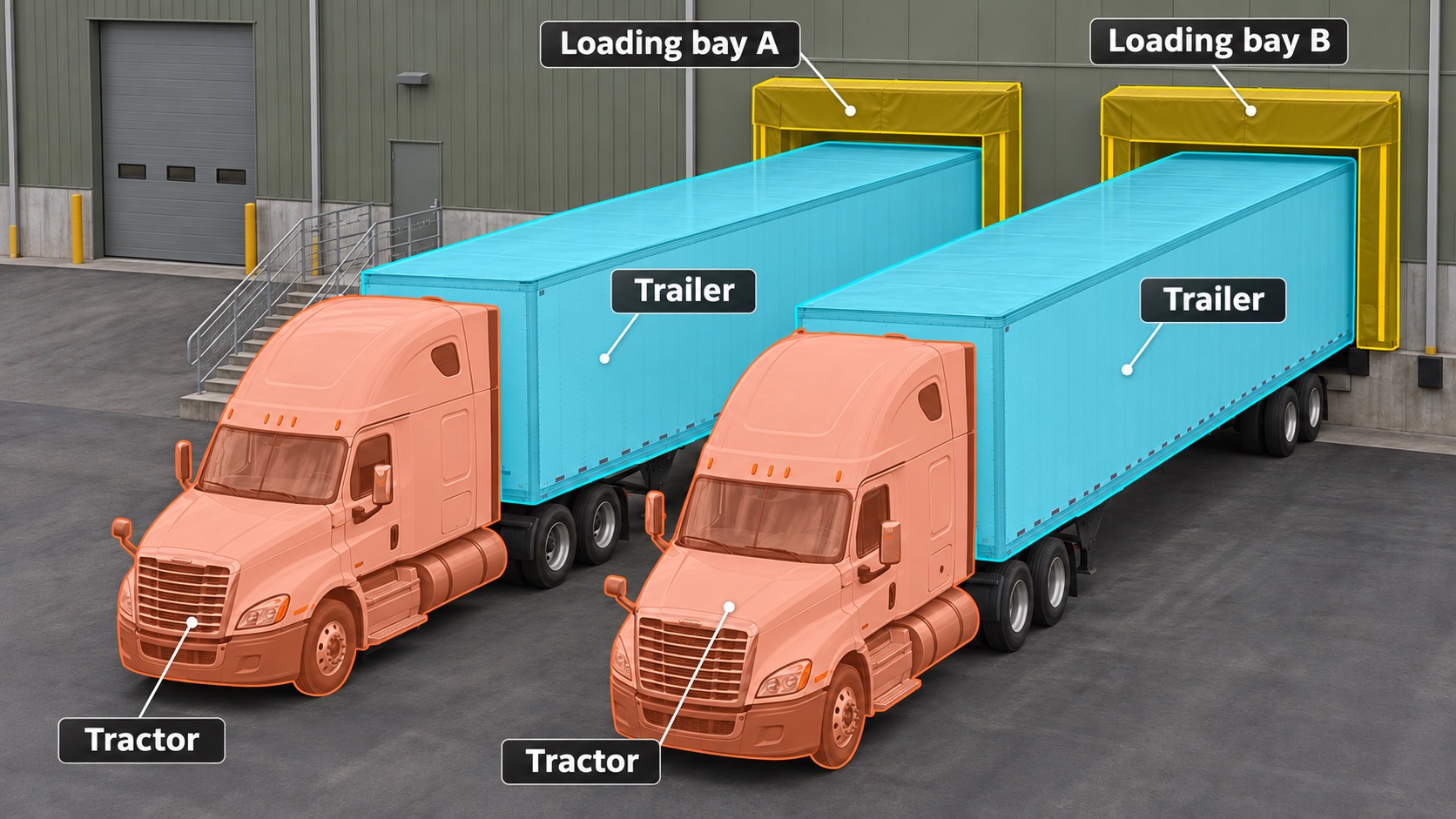
The first question is about state: which bay is occupied, by which trailer, and at what time? The tractor, trailer, and bay have distinct roles. A useful representation preserves those roles and the observations that support the occupancy finding.
What is an ontology?
In this context, an ontology is a formal description of the kinds of things in a domain, their properties, and the relationships that can hold between them. It also states meanings that software can use consistently. A loading bay is a kind of vehicle bay; a bay belongs to a site; an observation concerns an object or a space at a particular time.
The W3C’s OWL 2 Primer describes the basic building blocks as classes, properties, individuals, and data values. In ordinary language, these correspond to categories, relationships or attributes, particular things, and their recorded values. W3C, OWL 2 Primer.
Give the scene a consistent meaning
- Classes
- Vehicle, loading bay, passage, observation. Categories that can be reused across sites.
- Instances
- Truck 42, Bay B, Camera 3. Particular things in one site or observation session.
- Properties
- A bay’s width, an observation’s timestamp, or the camera that produced it.
- Relationships
- A vehicle occupies a bay; a bay belongs to a site; an observation provides evidence for an interval.
A list of labels is a starting point. An ontology adds meaning between the labels. A knowledge graph can then hold particular facts expressed using that vocabulary: Bay B is a loading bay, it belongs to the north yard, and a time-bounded observation places Truck 42 inside it. The ontology describes the concepts; the graph records the particular assertions. In the annotated dock example, tractors and trailers need separate identifiers: a change to the tractor attached to a trailer need not change which trailer occupies the bay.
This does not require inventing a comprehensive model of the world. Start with the questions the service must answer and define enough of the domain to make those answers precise. A parking-occupancy service and a pedestrian-flow service may share concepts such as space, object, observation, and interval while using different domain definitions.
How reasoning helps
Reasoning derives conclusions from observations, definitions, and stated assumptions. Different kinds of reasoning do different jobs.
Logical reasoning follows formal relationships. If every loading bay is a vehicle bay and Bay B is a loading bay, software can infer that Bay B is a vehicle bay. A query for vehicle bays can therefore include it without requiring a separate manual label. This conclusion follows from the definitions and assertions supplied to the reasoner.
Spatial and temporal reasoning evaluates what happened where and for how long. A processing pipeline can associate a tracked vehicle with a validated bay polygon and maintain an occupancy interval. Geometry calculations, tracking, duration arithmetic, and event thresholds generally need application logic or other processing alongside the ontology.
Interpretation under uncertainty considers plausible explanations. A stationary truck in a loading bay might be loading, waiting, parked, or broken down. A vision-language model can propose interpretations or request more evidence. The ontology supplies a vocabulary in which to express them; it does not make a plausible explanation true.
These functions can work together. The distinctions matter because a logical consequence, a measured interval, and a proposed explanation carry different evidential weight.
A specific case: ground-level receiving
Now consider a different receiving arrangement. A medium box truck has a wrapped load on its lowered tail lift beside a ground-level door, separate from the raised docks. A query for an available loading location must consider the vehicle, handling method, and configured role of each space.
Match the receiving arrangement to the task
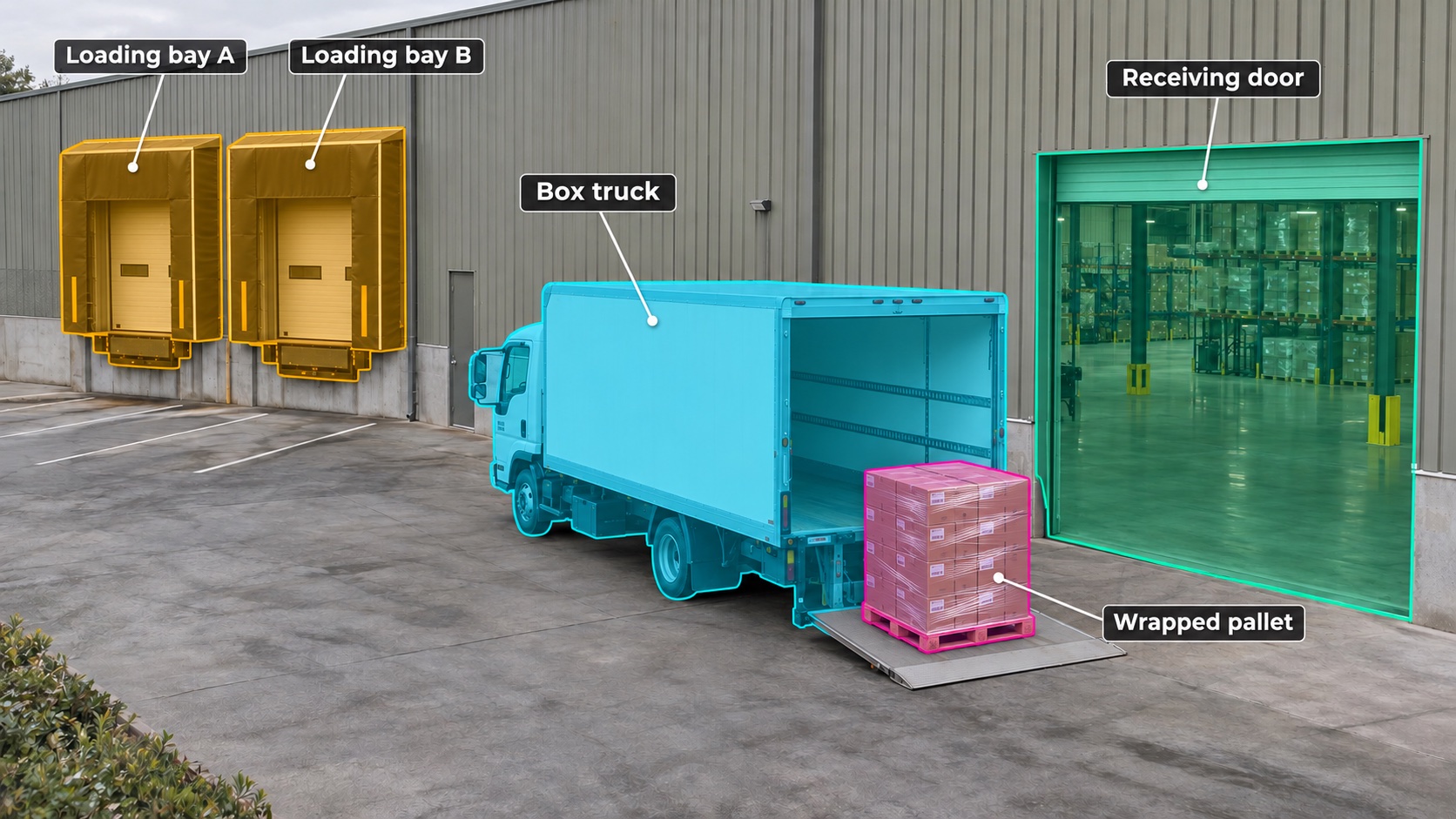
The loading arrangement is part of the context. Raised docks and ground-level receiving areas may support different vehicle and handling configurations. Dock design depends on the vehicles served and their cargo-floor heights; levelers bridge the designed difference between a dock and a vehicle bed. A site ontology can record these configured capabilities so that “available loading space” means a space suitable for the particular task. Rite-Hite, Designing the Right Loading Dock for Your Operation.
Follow one observation through to a result
Suppose an operator has validated Bay B’s boundary and configured a rule that flags occupancy longer than three minutes. In a separate fictional interval, a vehicle track remains in that bay from 14:00 to 14:04, with sufficient visibility and continuity under the agreed measurement procedure.
Keep each step of the conclusion visible
Loading bays are defined as a class of vehicle bay.
The track, bay geometry, and source frames support the association from 14:00 to 14:04.
The interval is calculated using the configured continuity and visibility rules.
The result is an extended-occupancy flag. Loading activity and permission remain unconfirmed.
The resulting record can include the bay, the observed vehicle track, the interval, the rule version, and links to the footage used to support it. If a reviewer changes the bay boundary or the rule, the system can identify which findings depend on that configuration. That traceability has to be implemented and stored; it does not come from naming the concepts alone.
What information can be extracted from a scene?
The useful outputs depend on the camera view, the available models, and the measurement definition. An ontology helps express those outputs consistently and connect them to their evidence.
- Objects and spaces
- Visible people, vehicles, seats, entrances, and defined regions. A region’s function may need plans or operator confirmation.
- Spatial relationships
- Objects within zones, tracks crossing boundaries, and objects beside or overlapping other objects. Physical distances require appropriate calibration.
- State and use
- Observed seat occupancy, bay occupancy, or passage obstruction under a specified rule. A blocked view should produce an unknown state.
- Events and intervals
- Arrivals, departures, dwell intervals, crossings, and changes in occupancy. Reliable timing depends on sampling, tracking, and visibility.
- Patterns over time
- Busy periods, recurring occupancy, movement flows, or queue estimates. Comparisons require consistent definitions and adequate coverage.
- Evidence and quality
- Source camera, observation time, model and rule versions, supporting clips, visibility gaps, and whether a finding has been reviewed.
These categories support practical questions: Which loading bays were occupied during an interval? Which occupied bays crossed a configured threshold? What evidence supports a finding? Where did missing observations prevent a complete answer?
Some questions require information beyond video. Whether a truck is authorized to use a bay may depend on a booking or permit. Whether a door should be locked depends on site policy. A camera’s view of a person standing near a seat does not establish that person’s intention to sit. External records and human confirmation should remain identifiable as separate sources.
Represent the observation as well as the object
A useful distinction is between a statement about the world and the observation that supports it. “Bay B was occupied” should carry a time interval, a procedure, and evidence. A later observation may differ without either record being erased.
The W3C/OGC Semantic Sensor Network ontology and its SOSA core provide a relevant pattern: an observation links the feature being studied, the property observed, the procedure, and the result. They also distinguish the time a result applies to from the time it was produced. This is useful when footage is processed after capture. W3C/OGC, Semantic Sensor Network Ontology, 2017 edition.
Time also needs more structure than a single timestamp. An obstruction can overlap a busy period, begin before an arrival, or persist after a vehicle departs. OWL-Time provides vocabulary for instants, intervals, durations, and temporal relationships. An application still has to establish those intervals from observations and perform the required calculations. W3C, Time Ontology in OWL.
Expected relationships can guide investigation
A site model can describe how a space is intended to work. A loading bay accommodates vehicles; an entrance connects areas; a passage is intended to permit movement. These relationships help a system formulate questions and select relevant observations.
For example, if an object overlaps a designated passage, a system can inspect whether it reduces the usable route under an agreed rule. It may need calibrated geometry, several views, or an operator’s assessment before reporting an obstruction. Knowing that a passage is intended to be traversable does not establish that it is currently clear.
Expected relationships are also useful for finding gaps. If a configured measurement requires a departure time but the track ends during an occlusion, the system can mark the interval incomplete. If a new barrier appears, it can request a review of affected zones. These are checks against a declared model of the site, not predictions of what must happen next.
Unknown information must stay unknown
OWL uses an open-world assumption: a missing statement is not automatically false. That principle is important for video. The absence of an observed vehicle does not establish an empty bay when the view is blocked or the observation is stale. W3C, OWL 2 Primer.
An operational system must define when it has enough coverage to make a bounded claim such as “no vehicle observed in this bay during this interval.” Keep visibility, freshness, and scope alongside the result. Confidence scores from visual models also need their own interpretation; logical entailment does not turn those scores into calibrated probabilities.
Data validation is a separate responsibility. SHACL, for example, validates RDF graphs against declared conditions. It can help check whether a record includes required fields, such as a source and an observation time. Passing that check establishes structural conformance, while the accuracy of the observation still requires evaluation against evidence. W3C, Shapes Constraint Language.
Build the ontology around the questions
For a proposed deployment, begin with a small set of questions and specify the concepts needed to answer them. Reuse common definitions where they fit, add domain concepts deliberately, and configure each site with validated geometry and local rules. Version those definitions and test what happens when observations are missing or contradictory.
Large models can help propose scene descriptions and candidate relationships. Situation-specific models and processing pipelines can maintain recurring observations. An ontology connects their outputs to shared meanings and gives downstream queries a stable structure. Proposed additions should be reviewed before they change the meaning of a production measurement.
This extends the argument in Scene understanding needs context. For Parallel Sight, the architectural aim is to make scene reasoning reviewable: each answer should identify the place, time, definition, and observations on which it depends. An ontology provides the vocabulary and formal relationships; the complete service must provide the perception, calculations, validation, and evidence.
Sources and scope
The examples and diagrams are conceptual. They describe an architectural approach and do not represent deployed endpoints or measured Parallel Sight performance. The standards below define knowledge representation, observation, time, and validation; they do not by themselves establish video-understanding accuracy.
- W3C — OWL 2 Web Ontology Language Primer. Classes, properties, individuals, reasoning, and the open-world assumption.
- W3C/OGC — Semantic Sensor Network Ontology, 2017 edition. Observations, procedures, features, results, and observation times.
- W3C — Time Ontology in OWL. Instants, intervals, duration, and temporal relationships.
- W3C — Shapes Constraint Language. Validation of RDF graphs against declared conditions.